Figma's Moat Was Never the Pixels
Generation is a commodity. Alignment is the moat.
This is an outside-in product strategy analysis of Figma's biggest open question in 2026: how should it grow its newest AI products when the underlying ability to turn a prompt into a design is becoming something anyone can buy? All figures are public and sourced at the end. Base facts are written as plain analysis. My own strategic calls are marked My take, and the arguments I think could prove me wrong are marked Counterpoint.
Already know where Figma stands in 2026? Skip the context and jump to the core problem →
Figma chose independence and inherited a fight. After the Adobe acquisition collapsed under regulatory pressure in 2023, Figma took a $1B breakup fee, used it to acquire AI startups and rebuild its canvas, and went public in July 2025. Revenue grew 41% in 2025, and Q1 2026 revenue reached $333.4M, up 46% year over year.
The company shipped an AI product line fast.
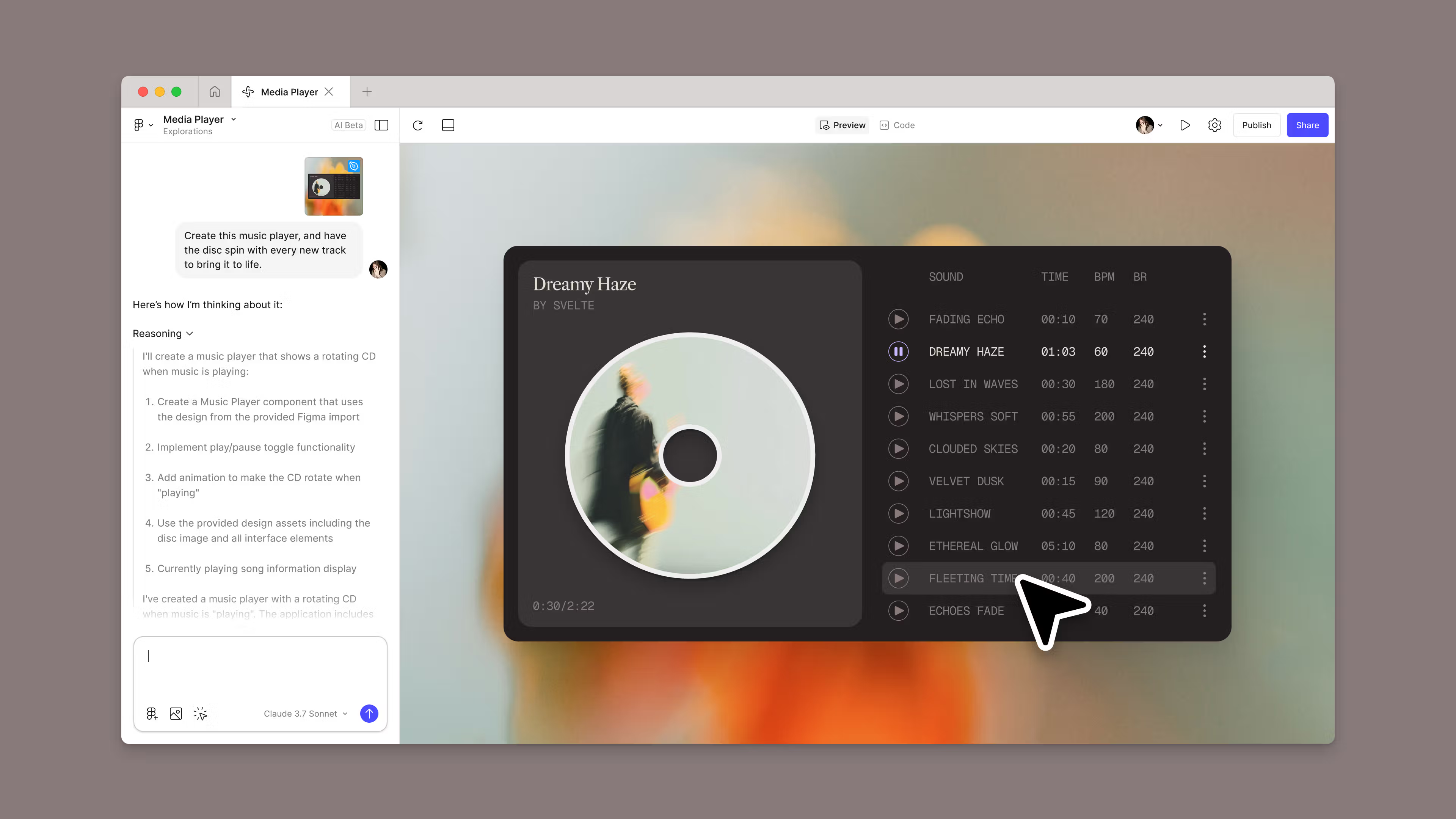
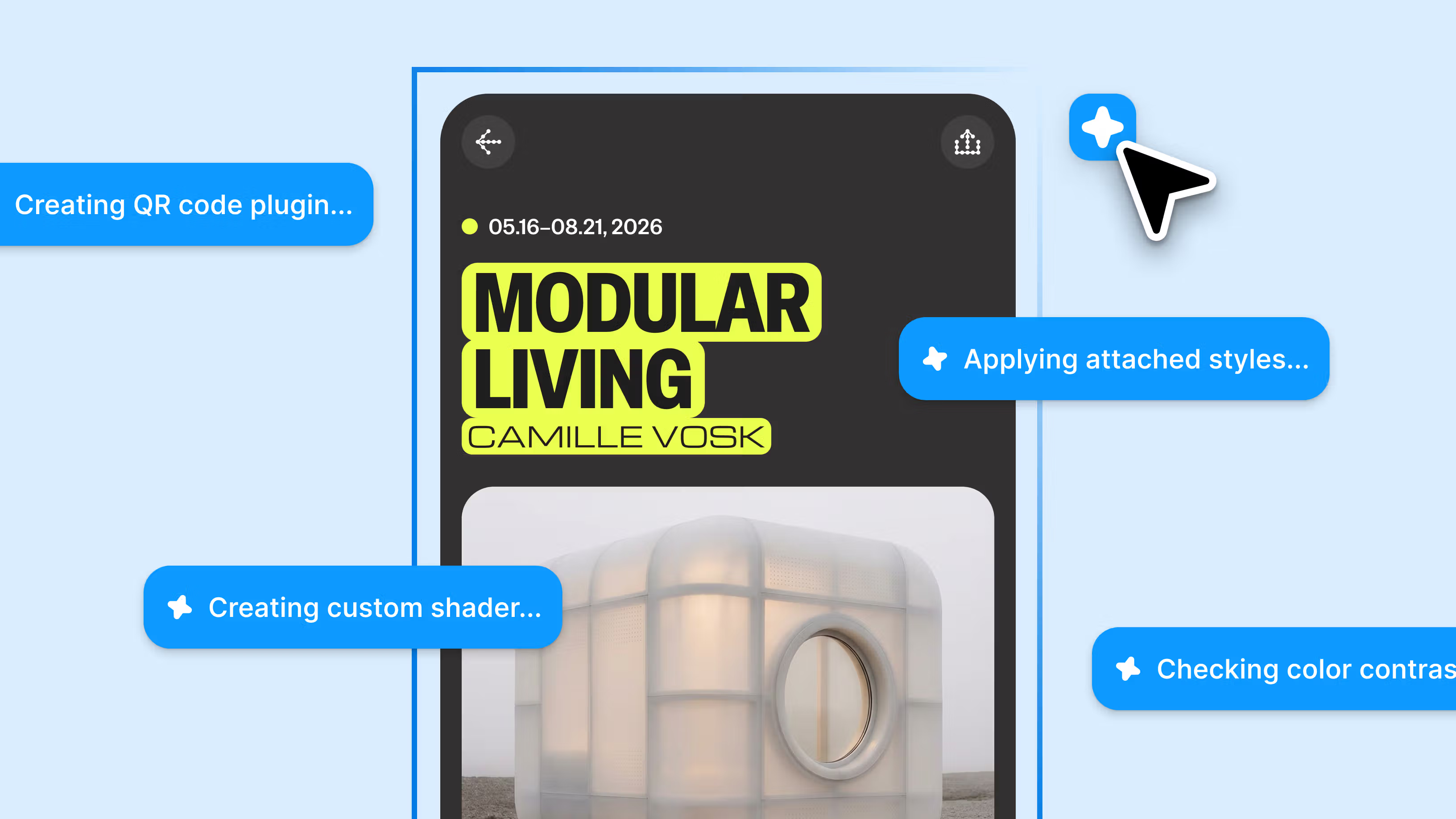
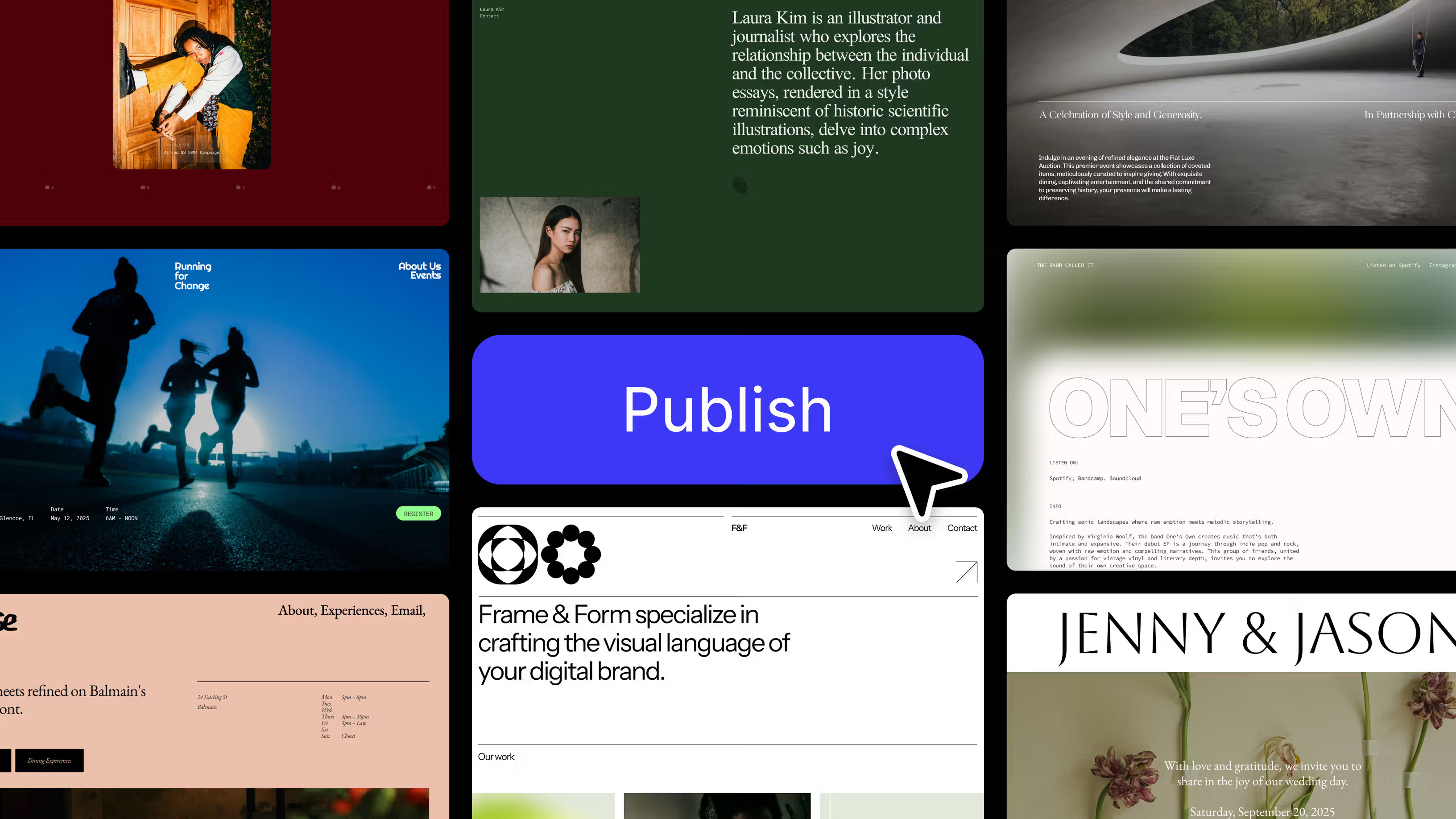
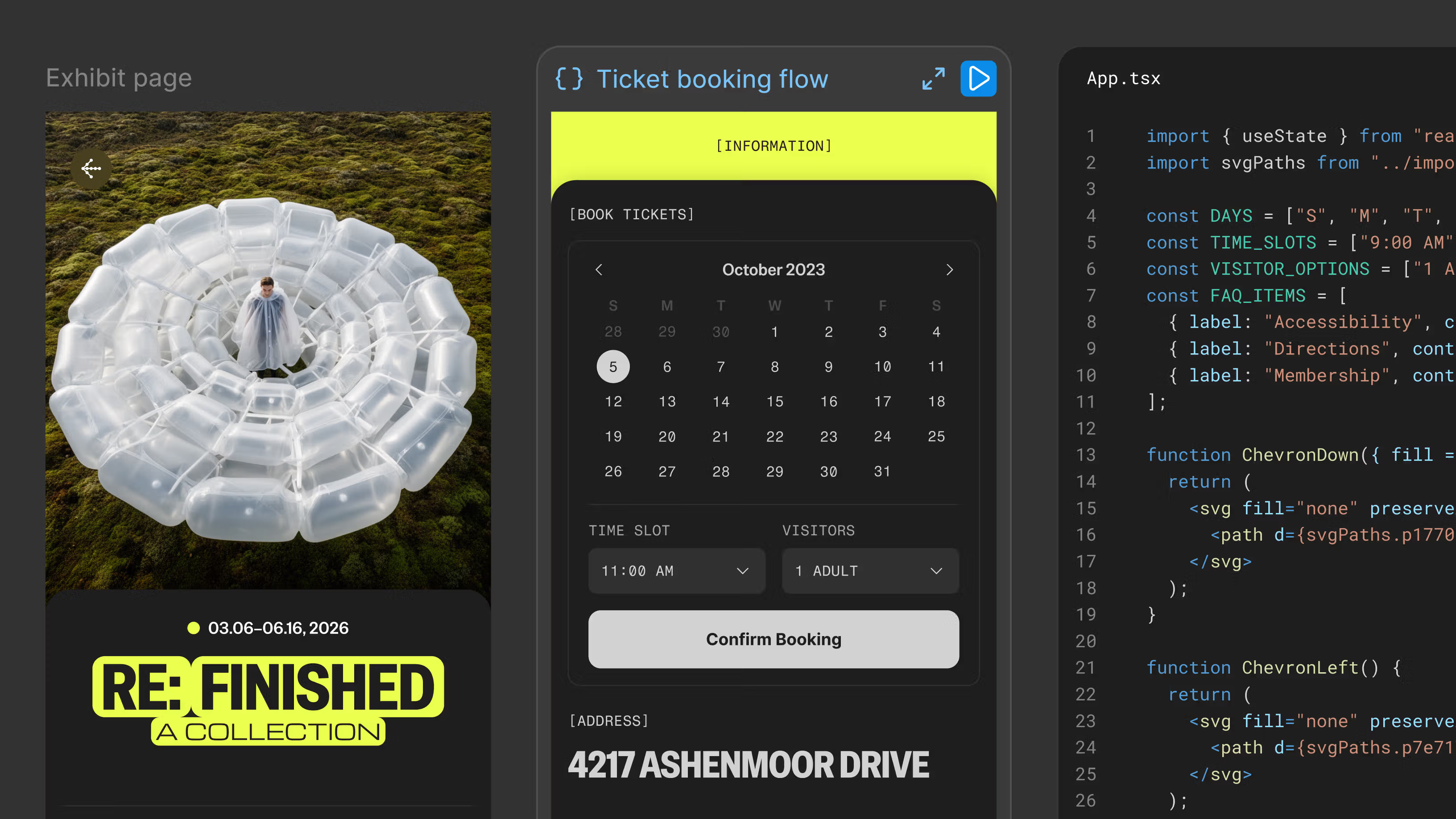
Source: Figma
Adoption at the platform level is healthy, but the margin tells the other half of the story. Gross margin fell from about 92% to about 86% over 2025, driven by large-scale AI inference costs. The AI that powers Figma's canvas is rented from OpenAI, Anthropic, and Google. As one observer put it, Figma spent its 2026 conference emphasizing human judgment while the AI running the canvas belongs to someone else.
Direct competitors are the familiar design tools: Adobe with Firefly AI, Canva pushing up from the non-designer market, and Sketch.
Indirect competitors are the real threat, because they let people skip the design step entirely. Prompt-to-app tools like Lovable, v0, Framer, and Webflow, plus developer tools like Cursor, Bolt, Replit, and Copilot, compress idea to shipped interface without a traditional design canvas. This is the "AI is killing Figma" narrative in concrete form.
The sharpest version is Anthropic itself, both supplier and competitor. Anthropic launched Claude Design, built on Claude Opus 4.7, and Figma's stock fell 7% that day. The symbolism runs deeper: Jenny Wen, formerly Figma's director of design, now leads design for Claude. The person who helped build Figma's interface is building the one that competes with it.
Four structural problems sit underneath the growth numbers.
Generation is commoditizing. Make, v0, and Stitch all ride on similar foundation models. Quality converges, and users are already locked into Claude, GPT, and Gemini. In a pure generation contest, the model owners win on distribution.
Dependency means lost leverage and margin. Renting models put a 6-point dent in gross margin in a single year, and the core value Figma sells is produced by someone else. The more Figma leans on a frontier model for the magic, the more the category learning and value capture accrue to the model owner.
Usage pricing created a trust problem. In March 2026 Figma layered usage-based AI credits on top of seats. A Full seat is $16 per month with 3,000 credits, but 1,000 top-up credits cost $24, which makes official credits about 5.6 times more expensive than spinning up a second "ghost" seat to generate from. Power users reported 3,000 credits lasting about 45 minutes. The sentiment was not "we want free AI," it was "we want fair pricing."
The strategic cannibalization risk is real, even if the data risk is not. Direct training-data leakage is unlikely, since commercial API terms generally exclude customer data from training and Figma's own content training is off by default for enterprise. The real risk is dependence: every dollar and prompt routed through a competitor's model strengthens that competitor's distribution and teaches the category that prompt-to-design works, with the value flowing to the model owner.
The instinct to call Figma a tool for designers is half right, and the half that is wrong matters most. Two-thirds of Figma's 13M+ monthly active users are not designers. About 30% of those are developers, and the rest are PMs, marketers, executives, and operations leads. The designer-to-non-designer ratio is roughly 1 to 3 or 4, and it has doubled since 2022. Figma itself is moving its definition of the customer from a job title to a behavior.
This is not speculative. Jenny Wen, now head of design at Claude, argues the traditional design process is dead. She estimates mockups and prototyping fell from 60-70% of design work to 30-40%, with a new 30-40% spent pairing directly with engineers, because engineering now ships in hours using multiple agents and designers can no longer gate that with months of discovery. The profession is splitting into execution support and short-horizon directional vision.
This decides what growth even means here. As of early 2025, Organization and Enterprise plans, sold through direct sales, made up about 70% of revenue, with self-serve at about 30%. And roughly 70% of those Organization and Enterprise customers first arrived on the Professional plan. This is a bottom-up, land-and-expand B2B business, confirmed by 139% net dollar retention driven by seat expansion.
Figma should not try to win the generation war. It should move its value to the layer the models cannot reach: where multiple humans and multiple agents decide together, inside a shared system, and ship to production.
The moat has three real layers: the design system and component libraries, the collaboration graph plus file format plus handoff, and the designer community. None of these exist inside a standalone model chat. They are the context that breaks when you switch tools, which is the real substance behind "the output feels off when I move between tools."
These are the five moves I would make, in priority order. Each one targets something a rented model cannot replicate. The first two compound the fastest, so that is where I would start.
Rent the model, but own the yardstick and the ground-truth data. Owning what good output looks like, plus the accumulated record of what users actually accept, is more defensible than owning any single model, because models change every six months while the standard and the acceptance data compound.
- Axes, not a single score. System fidelity (did it use the team's real components and tokens), voice fidelity, structural correctness (does it survive across breakpoints), accessibility, intent alignment (does it match the prompt plus the comment thread), and handoff quality.
- A golden set plus human-validated references. Representative tasks crossed with team contexts and the outputs people accepted.
- A two-part scorer. Deterministic rule checks for cheap, objective dimensions (token usage, contrast, layer hygiene) and model judges for subjective ones. Pushing the objective checks to rules cuts expensive judge calls, which is itself a margin lever.
- Evidence, not just a verdict. Highlight where it failed, which turns the harness from internal QA into a user-facing feature.
- A regression gate for model swaps. When you swap models or a version bumps, output must clear the bar before shipping. This is what solves model character drift, turning model choice into a measured decision.
- A feedback loop from real acceptance. Capture whether users accepted, edited, or rejected outputs, calibrated per team rather than to a global average. This is where the moat compounds, because the model owners never see that data.
The honest hard part: good design is partly subjective and varies by context, so a fixed rubric fails. The harness has to be the living-acceptance version, where the standard keeps updating.
applied →
Generation in Claude or GPT is single-player. Figma's wedge is an agent that operates inside a shared file alongside multiple humans and the design system. Picture an agent that reads a PM's comment thread and a designer's component library and produces a change everyone can see and approve in context. The room is the context the team owns: the file, the comments, the design system, the decision history, and the people. The agent's value is being native to that room, which a standalone model chat can never be. The value is not the artifact, it is the aligned decision in context.
Store not just the output but the why: the comments, the rejected alternatives, the rationale. Models produce output but hold no memory of a team's decision history. Figma can be the memory layer that any model generates against, the way the repo keeps an IDE relevant even as the model becomes a swappable input. Manage growing history with retrieval rather than ever-longer context windows. The enterprise payoff: when people leave, the context does not. That is organizational memory, a CFO-grade argument.
Visual tokens exist as variables. Voice tokens do not. A voice-token layer makes any model's output on-brand and on-system, something the foundation-model tools cannot do because they do not know your system. Cold start has two modes: extract voice from existing brand assets for enterprises, and propose a sector-default archetype for zero-to-one makers, then refine. Grounding is also a margin lever: fewer regenerate loops, the option to use a cheaper model, and rule-based fill for tokenized parts. Code Connect already cut inference about 30% by grounding designs in the system.
With 30-40% of design work now pairing with engineers, and Figma already owning the design-to-code path, the defensible spot is where human design intent and agent-generated code are reconciled. That reconciliation is model-proof.
The thread through this analysis is a preference for behavior over capability. The interesting question about an AI feature is not what it can generate, it is whether a person, in their actual context, will accept and act on what it produced. That is the same question behind a behavioral evaluation framework I built for how AI models respond across cultures, tested across four frontier models, three languages, and six everyday scenarios with 50+ user evaluations, where the finding was that models tend to default to one culture's assumptions even when the language changes. Neutral is not neutral.
The evaluation harness in Move 1 is that same idea applied to a different domain: define and measure what good, accepted output looks like, independently of the model producing it. Generation is becoming free. Judgment about whether an output belongs is not, and that is where durable products will be built.
- Figma Q1 2026 Financial Results (BusinessWire)
- FIG Q1 2026 Earnings, 46% growth, NDR 139% (BigGo Finance)
- Figma S-1 breakdown, revenue mix (Tanay Jaipuria)
- Why two-thirds of Figma users are not designers (Medium)
- The design process is dead, Jenny Wen (Lenny's Newsletter)
- Figma bets on human judgment while the AI belongs to someone else (The Decoder)
- Anthropic launches Claude Design, challenges Figma (VentureBeat)
- Figma partners with OpenAI and Anthropic for AI agent (Dataconomy)
- From Claude Code to Figma, Code to Canvas (Figma Blog)
- Why is 1 AI credit 6x more expensive than a Full seat credit (Figma Forum)
- Cursor revenue and Composer model margin (Sacra)
- Perplexity Computer, routing across 20+ models (OpenTools)
- Notion restores access to Anthropic after disruption (TechCrunch)
- Toss Design System, componentization by A/B metrics (Toss Tech)
- Toss UX writing and voice consistency (Toss Tech)